

Diffusion Forcing: what happens when next-token prediction meets full-sequence diffusion.
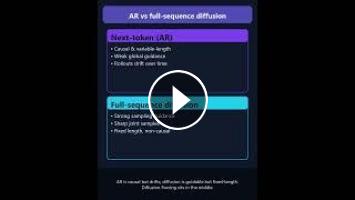
There are two ways to generate a sequence, and each has a weak spot. Next-token models (LLMs) are causal and can run to any length, but over long rollouts small errors pile up and the output drifts. Full-sequence diffusion models (think Sora) denoise a whole fixed-length clip at once and can be guided toward good trajectories, but they cannot grow past that length or generate causally.
Diffusion Forcing, from MIT (NeurIPS 2024), unifies both with one simple move: train a diffusion model to denoise tokens that each carry their own independent noise level. Treat noise as a soft, fractional mask - zero noise means a token is fully observed, maximum noise means fully hidden, and everything in between is partial. One causal model now spans pure next-token prediction, full-sequence diffusion, and every mixture.
Why it matters:
- Training is a standard per-token denoising loss - easy to add.
- At sampling you pick any per-token schedule on a 2D grid (tokens by steps), keeping the future noisier while you commit the present, so long rollouts stay stable.
- It beat six baselines on 2D maze planning and carries latent memory for robot imitation. Its successor, the Diffusion Forcing Transformer (DFoT, ICML 2025), rolls out extremely long, consistent videos.
Reach for it on long-horizon video, planning, and control. For plain text, ordinary next-token models are still simpler and stronger.
Did this make Diffusion Forcing click? Follow for plain-English GenAI breakdowns.
#GenAI #DiffusionModels #MachineLearning #AIresearch #DeepLearning
- Категория
- AI Картинки
Выполните вход или зарегистрируйтесь для отправки комментария.
Комментариев нет.
Следующее
Auto
-
00:17

forcing two AIs to count together #aimemes #memes #chatgpt
-
01:01
How Stable Diffusion Turns words into reality | GenAI Models Explained Part4 #generativeai #ai
-
05:44
Consistency Models Explained: Generate Images in One Step Instead of Fifty #genai #ai #llm
-
01:00
How AI Compresses and Recreates Reality | Auto Encoders VAEs GenAI Models Part3 #generativeai #ai
-
00:48
Why AI Destroys Images to Create Art | Diffusion Model GenAI Models Part1 #generativeai #ai
-
05:22
DeepCache Explained: Speed Up Stable Diffusion by 2-4x #genai #llm #ai
-
07:32
How Modern Generative Algorithms (VAEs, GANs, Diffusion Models, Autoregressive Models) Actually Work
-
00:23
Stop Paying for AI APIs! Get Free Access to 100,000+ Models Now #AI #API #Startups #Free #Tech #LLM
-
06:25
The Future of Stable Diffusion: Distribution Matching Distillation #genai #ai #llm
-
01:40
LoRA models #lora #ai #genai #googlestudents #shortvideo #llm #stablediffusion
-
13:39

Best AI Tools For Research in 2026 (Beats ChatGPT & 0% Detection)
-
00:37

3 AI tools for programmers
-
00:55

The Best AI Tools For Content Creators
-
00:58

7 AI tools you NEED to try!
-
00:12

Best AI Tools For Hacker
-
11:15

10 Best AI Tools You MUST Try in 2025
-
00:28

The most popular AI tools right now... which one is best?
-
00:36
Best Free AI Tools for Research Papers & Essays | Write Smarter!
-
14:34

Google's NEW AI Tools Will BLOW YOUR MIND | Google I/O 2026
-
00:18

Best FREE AI Tools for Designers | Boost Your Creativity #ai #aitools #graphicdesign #designer
 Загрузка...