

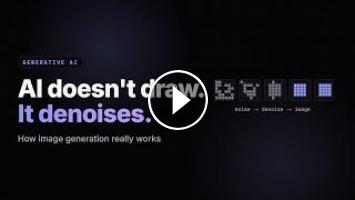
AI doesn't paint your image stroke by stroke, and it doesn't copy one from a library. It starts from static and denoises.
Diffusion models sculpt a picture out of pure random noise, guided by your words. We trace the whole process end to end — how noise gets added, how a network learns to remove it, how text steers the result, and the trick that makes it fast.
What you'll learn, visual-first:
• The reframe — it doesn't draw or fetch; it denoises an image out of static.
• The forward process — adding Gaussian noise to real images to build the training data.
• The reverse process — one network that predicts the noise, run many times (U-Net / transformer).
• Text guidance — CLIP embeddings, cross-attention, and the guidance scale (classifier-free guidance).
• Latent diffusion — why Stable Diffusion denoises a tiny latent, then decodes (VAE) for speed.
• The knobs — sampling steps and guidance scale, and where pushing them too far breaks.
• Why hands get extra fingers — locally plausible patches with no global count.
AI doesn't draw. It denoises.
Chapters:
0:00 Not painted, not fetched — denoised
1:00 It doesn't draw — it denoises
2:00 The forward process — making noise
3:03 The reverse process — a denoiser
4:08 Text guidance — steering it
5:40 Latent diffusion — why it's fast
6:51 The knobs — steps & guidance
7:47 Pushing the dials — where it breaks
9:53 Noise → image, traced
—
datarekha — intuitive explainers for AI, ML & CS. The tech changes; the concepts don't.
New concept every few days — Subscribe so the next one finds you.
- Категория
- AI Картинки
Выполните вход или зарегистрируйтесь для отправки комментария.
Комментариев нет.
Следующее
Auto
-
07:32

How Modern Generative Algorithms (VAEs, GANs, Diffusion Models, Autoregressive Models) Actually Work
-
12:32
How AI Image Generators Really Work (Diffusion Explained)
-
00:40
How Diffusion Models Work 20260704 — AI Explained
-
00:38
How Does AI Image Generation Work? — Diffusion Models Explained #midjourney #dalle #diffusion
-
09:57
Latent Diffusion Models Explained: How Stable Diffusion, SDXL, SD3 & Flux Generate Images
-
01:17
How AI Diffusion Models Work (Explained in 1 Minutes) ⏱️
-
04:11
Diffusion Models Explained: DDPM, DDIM, Latent Diffusion and Stable Diffusion
-
08:58
13. Diffusion Models Explained | Stable Diffusion, DDPMs & Real-World Applications
-
02:53
How AI Image Generators Work: Diffusion, Explained #Shorts
-
08:50
Diffusion Models Explained | Stable Diffusion, U-Net, Transformers & Generative AI
-
13:39

Best AI Tools For Research in 2026 (Beats ChatGPT & 0% Detection)
-
00:37

3 AI tools for programmers
-
00:55

The Best AI Tools For Content Creators
-
00:58

7 AI tools you NEED to try!
-
00:12

Best AI Tools For Hacker
-
11:15

10 Best AI Tools You MUST Try in 2025
-
00:28

The most popular AI tools right now... which one is best?
-
00:36
Best Free AI Tools for Research Papers & Essays | Write Smarter!
-
14:34
Google's NEW AI Tools Will BLOW YOUR MIND | Google I/O 2026
-
00:18

Best FREE AI Tools for Designers | Boost Your Creativity #ai #aitools #graphicdesign #designer
 Загрузка...