

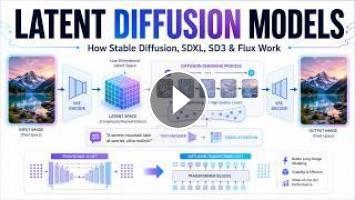
Latent Diffusion Models are the foundation behind Stable Diffusion, SDXL, SD3, Flux, and many modern image generation systems.
Instead of generating high-resolution images directly, these models compress images into a smaller latent space using a Variational Autoencoder, then train a diffusion model to denoise that compressed representation. This makes image generation faster, cheaper, and practical enough to run on consumer hardware.
In this video, we break down how latent diffusion works, why VAEs matter, how text prompts guide image generation through cross-attention, and why newer models are moving from U-Net architectures to Diffusion Transformers.
You will learn:
↳ How Stable Diffusion uses latent space
↳ Why VAEs reduce compute cost
↳ How diffusion denoising works
↳ What CFG does during generation
↳ How cross-attention connects text and images
↳ Why SDXL, SD3, and Flux use more scalable architectures
↳ How quantization helps run large models locally
This is a practical technical guide for anyone learning generative AI, diffusion models, multimodal AI, or modern image generation systems.
How Stable Diffusion Really Works: Latent Diffusion, VAEs, CFG & Cross-Attention
Latent Diffusion Explained: The Architecture Behind Stable Diffusion and Flux
From Stable Diffusion to Flux: The Evolution of Latent Diffusion Models
- Категория
- AI Картинки
Выполните вход или зарегистрируйтесь для отправки комментария.
Комментариев нет.
Следующее
Auto
-
04:43

GitHub - CompVis/stable-diffusion: A latent text-to-image diffusion model
-
09:59
SDXL: Scaling and Refining Latent Diffusion Models | Stable Diffusion XL | Stability AI
-
06:18
Latent Diffusion: diffuse in the latent, not in pixels
-
07:39
Flow Matching Explained: The Fast Generative AI Behind Flux and Stable Diffusion 3
-
07:32
How to Generate AI Images: GANs, Stable Diffusion & Visual Language Models Explained in 8 Minutes.
-
10:19
Google Colab FREE AI Image & Video Generator- SDXL Turbo, SDXL Lightning, AnimateDiff & CogVideoX-2B
-
00:48
How Diffusion Models Make Images from Noise: Stable Diffusion Explained #Shorts
-
04:11
Diffusion Models Explained: DDPM, DDIM, Latent Diffusion and Stable Diffusion
-
05:18
Stable Diffusion Explained: Core Principles, Latent Spaces & Text-to-Image Pipelines
-
18:45
26.3 | Latent Diffusion Models (LDM
-
13:39

Best AI Tools For Research in 2026 (Beats ChatGPT & 0% Detection)
-
00:37

3 AI tools for programmers
-
00:55

The Best AI Tools For Content Creators
-
00:58

7 AI tools you NEED to try!
-
00:12

Best AI Tools For Hacker
-
11:15

10 Best AI Tools You MUST Try in 2025
-
00:28

The most popular AI tools right now... which one is best?
-
00:36

Best Free AI Tools for Research Papers & Essays | Write Smarter!
-
14:34

Google's NEW AI Tools Will BLOW YOUR MIND | Google I/O 2026
-
00:18

Best FREE AI Tools for Designers | Boost Your Creativity #ai #aitools #graphicdesign #designer
 Загрузка...