

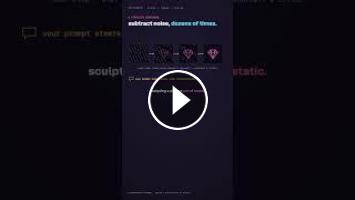
How does typing 'an astronaut riding a horse' become a photo that never existed? Image models like Midjourney and Stable Diffusion do it with a strange trick: they start with pure noise and remove it. That's diffusion. Here's the counterintuitive part: to learn to create images, the model first learns to destroy them. You take a real photo and add noise, step by step, until it's pure static. Then the model learns to run that in reverse - given a noisy image, predict the noise and subtract it. Do that starting from nothing but static, and an image appears. So generation works like this: start with a canvas of random noise; the model predicts what noise to remove to nudge it closer to the prompt; subtract a little; then look again and repeat, often dozens of times. Each pass, the static resolves a bit more, until a sharp image emerges. Your text prompt steers every step (that's called conditioning). It's sculpting a picture out of noise. The cost is speed: every denoising step is a full run of the model, which is why images take seconds, not milliseconds. It can still fumble fine details (hands and in-image text used to be classic tells, though the newest models have largely fixed both), and it only knows what it was trained on. The big speed fix is latent diffusion - denoising in a compressed space instead of on every pixel. This one idea runs the whole image-generation boom: Stable Diffusion, Midjourney, Flux, and Google's Imagen are all diffusion models. And it didn't stop at images - the same denoising trick now generates video, audio, and even 3D shapes.
Full lesson (11 free, no signup): https://systemdesign.academy/go/diffusion
#Diffusion #AIArt #StableDiffusion #Midjourney #AI #MachineLearning #GenerativeAI #SystemDesign #Shorts
Full lesson (11 free, no signup): https://systemdesign.academy/go/diffusion
#Diffusion #AIArt #StableDiffusion #Midjourney #AI #MachineLearning #GenerativeAI #SystemDesign #Shorts
- Категория
- AI Картинки
Выполните вход или зарегистрируйтесь для отправки комментария.
Комментариев нет.
Следующее
Auto
-
01:17

How AI Diffusion Models Work (Explained in 1 Minutes) ⏱️
-
00:48
How Diffusion Models Make Images from Noise: Stable Diffusion Explained #Shorts
-
12:32
How AI Image Generators Really Work (Diffusion Explained)
-
00:38
How Does AI Image Generation Work? — Diffusion Models Explained #midjourney #dalle #diffusion
-
09:26
How Diffusion Turns Random Numbers Into an Image | Diffusion Visually Explained
-
05:16
How AI Image Generators Actually Work (Explained Simply)
-
06:30
Stable Diffusion AI | Stable Diffusion Explained | In Hindi | Text-To-Image Generation |ALGOBRAIN AI
-
04:11
Diffusion Models Explained: DDPM, DDIM, Latent Diffusion and Stable Diffusion
-
00:40
How Diffusion Models Work 20260704 — AI Explained
-
10:58
How AI Image Generators Work: Diffusion Models Explained
-
13:39

Best AI Tools For Research in 2026 (Beats ChatGPT & 0% Detection)
-
00:37

3 AI tools for programmers
-
00:55

The Best AI Tools For Content Creators
-
00:58

7 AI tools you NEED to try!
-
00:12

Best AI Tools For Hacker
-
11:15

10 Best AI Tools You MUST Try in 2025
-
00:28

The most popular AI tools right now... which one is best?
-
00:36
Best Free AI Tools for Research Papers & Essays | Write Smarter!
-
14:34
Google's NEW AI Tools Will BLOW YOUR MIND | Google I/O 2026
-
00:18

Best FREE AI Tools for Designers | Boost Your Creativity #ai #aitools #graphicdesign #designer
 Загрузка...