

Robotic Arm Drives Rows of Fasteners Automatically for Faster Wood Assembly
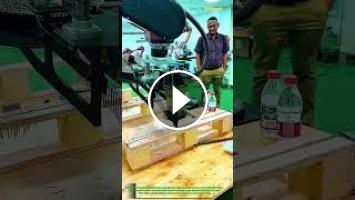
This robotic arm drives rows of fasteners automatically, creating faster wood assembly with repeatable spacing, controlled depth, and less physical strain for the operator.
Technical Specifications of the Robotic Fastening System
- Machine type: Multi-axis industrial robotic arm equipped with an automated fastening end effector.
- Main process: Repetitive placement and driving of fasteners into prepared wooden components.
- Workpiece material: Layered timber, plywood, engineered wood, or similar assembly panels.
- End-effector function: Holds, positions, and drives each fastener at programmed coordinates.
- Motion control: Programmable robotic movement for repeatable X, Y, Z, and angular positioning.
- Fastener supply: Guided magazine or feeder system that continuously presents fasteners to the driving head.
- Fixture system: A rigid wooden jig supports the workpiece and keeps every panel in a fixed position.
- Depth control: Adjustable driving force, stroke, or torque helps produce consistent penetration.
- Safety requirement: The cell should use guarding, emergency stops, controlled access, and safe operating procedures.
- Suitable applications: Furniture frames, wooden packaging, panel products, pallet components, modular structures, and repetitive workshop assembly.
Tool Functions
1. The robotic arm moves the fastening head to every programmed point without requiring the operator to reposition the tool manually. This is especially useful when a panel contains long rows of identical fastening locations.
2. The automated end effector drives each fastener with controlled pressure, depth, and alignment. Consistent insertion helps prevent loose joints, overdriven heads, damaged surfaces, and irregular assembly quality.
3. The feeder keeps fasteners available near the driving head, reducing interruptions caused by hand loading. A stable supply allows the robot to continue the fastening sequence with shorter pauses between cycles.
4. The wooden fixture holds the components securely while the robot works. Accurate fixturing is essential because the programmed coordinates only remain reliable when every workpiece is placed in the same reference position.
5. The control system stores repeatable movement patterns for different products. Operators can modify spacing, row length, fastening order, and tool position when the production design changes.
How the Robotic Fastening Process Works
1. The operator places the wooden components inside the fixture and checks that all edges, reference points, and joint surfaces are correctly aligned. Secure clamping prevents the material from shifting during fastening.
2. The selected robot program defines the exact path, fastening coordinates, approach angle, working height, and sequence. The arm then moves the tool toward the first location at a controlled speed.
3. Sensors, mechanical guides, or programmed offsets position the fastening head over the target point. The tool contacts the wood and drives the fastener to the required depth using controlled force, torque, or pneumatic pressure.
4. After completing one point, the robot retracts, moves to the next coordinate, and repeats the same cycle. This creates straight rows with uniform spacing while maintaining a stable production rhythm.
5. When the full pattern is complete, the robot returns to a safe position. The operator inspects fastening depth, joint stability, material condition, and dimensional accuracy before removing the completed assembly and loading the next set.
This robotic fastening process keeps every fastener aligned, evenly spaced, and consistently driven across wooden panels. Compared with manual fastening, it can improve efficiency by around 60% while reducing fatigue, missed points, and uneven assembly results. The percentage is a practical production estimate and can vary according to panel size, fastener count, feeder reliability, robot speed, fixture quality, and operator setup. The main reason for using this system is not simply speed. It also provides repeatability, traceable programming, predictable cycle times, and more stable joint quality during high-volume work. Manual fastening remains useful for prototypes, repairs, irregular products, and low-volume jobs, but a programmed robotic arm becomes more effective when the same pattern must be repeated hundreds or thousands of times.
Like this robotic fastening process, comment on the precision, and subscribe for more industrial automation, woodworking, manufacturing, work skills, and production process videos.
#innovative #innovation #work #skills #process #job #roboticarm #fastening #woodassembly #manufacturing #automation
- Категория
- AI для YouTube & Shorts
Выполните вход или зарегистрируйтесь для отправки комментария.
Комментариев нет.
Следующее
Auto
-
00:04

Automatic Wood Edge Trimming Machine Delivers Perfect Precision
-
00:42
One Trick Clears Entire Blank Rows — emphasizes simplicity #excel #exceltips #excelforbeginners
-
00:12
Industrial robot#robots#industrial #welding #painting #Automation
-
00:11
How 10,000,000 Stainless Steel Nail Clippers Are Stamped Inside a Satisfying Factory ✂️️⚡#factory
-
00:21
How Hard Drives Are Made | Inside the HDD Factory Process
-
29:01
Brand Journalism's Second Act: How Earned Media Drives AI Search Visibility
-
01:42
I USED THE SAME NAIL ART IN DIFFERENT AI APPS THIS ONE IS MY FAVORITE
-
00:11
Industrial robot#robots#industrial #welding #painting #Automation
-
00:27
Select Rows Like a Pro — One move saves time #excel #spreadsheetmagic #excelforbeginners #exceltips
-
00:10
Industrial robot#robots#industrial #welding #painting #Automation
-
13:39

Best AI Tools For Research in 2026 (Beats ChatGPT & 0% Detection)
-
00:37

3 AI tools for programmers
-
00:55

The Best AI Tools For Content Creators
-
00:58

7 AI tools you NEED to try!
-
00:12

Best AI Tools For Hacker
-
11:15

10 Best AI Tools You MUST Try in 2025
-
00:28

The most popular AI tools right now... which one is best?
-
00:36

Best Free AI Tools for Research Papers & Essays | Write Smarter!
-
14:34

Google's NEW AI Tools Will BLOW YOUR MIND | Google I/O 2026
-
00:18

Best FREE AI Tools for Designers | Boost Your Creativity #ai #aitools #graphicdesign #designer
 Загрузка...