

Water is one of the most important resources on Earth.
Every home needs water. Every farmer needs water. Restaurants, hotels, hospitals, schools, offices and factories all depend on water. Food production, manufacturing, construction, energy generation and almost every economic activity are connected to water.
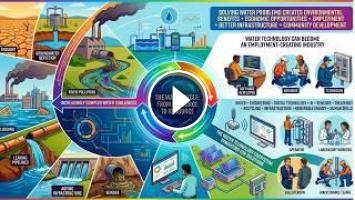
But the world is facing increasingly complex water challenges:
Water scarcity
Groundwater depletion
River and lake pollution
Industrial wastewater
Sewage
Flooding
Droughts
Leaking pipelines
Ageing infrastructure
Inefficient irrigation
Increasing urban demand
Poor water-quality monitoring
These challenges are creating a major opportunity for a new generation of businesses and technologies.
That opportunity is the Water Technology Industry.
Water technology is not simply about producing water filters. It is a much larger ecosystem involving:
Water + Engineering + Digital Technology + AI + Sensors + Treatment + Recycling + Infrastructure + Renewable Energy + Human Skills
The basic objective is:
Find water, protect water, treat water, save water, reuse water and manage water intelligently.
And there is another important opportunity.
Water technology can become an employment-creating industry.
A single water project can require engineers, technicians, electricians, plumbers, software developers, equipment manufacturers, drivers, operators, laboratory workers, salespeople, project managers and maintenance teams.
Therefore, solving water problems can simultaneously create:
Environmental benefits + Economic opportunities + Employment + Better infrastructure + Community development
2. What Exactly Is the Water Technology Industry?
The Water Technology Industry is the collection of businesses, technologies, products and services that help society manage water more efficiently and safely.
It covers the complete water cycle.
A simplified model is:
Water Source
↓
Collection
↓
Testing
↓
Treatment
↓
Storage
↓
Distribution
↓
Consumption
↓
Wastewater Collection
↓
Treatment
↓
Reuse / Safe Discharge
↓
Resource Recovery
The industry can provide technology and services at every stage.
Examples
A company may manufacture:
Water filters
Pumps
Sensors
Smart meters
Water tanks
Treatment equipment
Membranes
Irrigation systems
Another company may provide:
Water testing
Leak detection
Equipment installation
Wastewater treatment
Maintenance
Water audits
Digital monitoring
Another company could develop:
AI water-management software
Smart-city water platforms
Digital twins
IoT monitoring systems
So, Water Technology is an ecosystem, not one product.
3. The Most Important Practical Question
Instead of asking:
“What water technology can we sell?”
A better question is:
“What water problem exists around us, and what practical solution can we provide?”
For example:
A hotel may be spending too much money because of water leakage.
A factory may be using fresh water unnecessarily.
A farmer may be over-irrigating crops.
An apartment building may not know how much water each section consumes.
A municipality may not know where water is being lost in its distribution network.
A restaurant may have leaking taps and inefficient cleaning practices.
These are all potential business opportunities.
4. Water Technology Is Not Only High-Tech
This is extremely important.
When people hear “Water Technology,” they may imagine expensive AI systems and huge desalination plants.
But practical water technology can be very simple.
For example:
Problem
A school has a leaking overhead tank.
Solution
Install:
Water-level sensor
Automatic pump controller
Overflow alarm
This is already a water-technology solution.
Another example:
Problem
A farm is irrigated every morning regardless of soil moisture.
Solution
Install a soil-moisture sensor and automated irrigation controller.
Again, simple technology can solve a real problem.
Therefore:
Good water technology does not always mean complicated technology.
The best technology is often the technology that solves a real problem at an affordable cost.
5. Water Technology Industry Segments
The industry can be divided into several major areas.
1. Drinking-Water Treatment
Making water suitable for its intended use.
2. Wastewater Treatment
Treating water after it has been used.
3. Water Recycling
Treating water so it can be reused for suitable applications.
4. Desalination
Producing freshwater from seawater or brackish water.
5. Smart Water Management
Using sensors, meters and software to monitor water systems.
6. Leak Detection
Finding water losses before they become major problems.
7. Agricultural Water Technology
Helping farmers manage irrigation more efficiently.
8. Industrial Water Management
Helping factories reduce, treat and reuse water.
9. Rainwater Management
Collecting and managing rainfall.
10. Water-Quality Monitoring
Testing and continuously monitoring water conditions.
11. Digital Water Technology
Using AI, IoT, cloud systems, GIS and digital twins.
12. Water Infrastructure
- Категория
- AI Инструменты
Выполните вход или зарегистрируйтесь для отправки комментария.
Комментариев нет.
Следующее
Auto
-
00:09

Automatic 5 Gallon Water Bottle Cap Placing Machine | Water Bottling Line #cappingmachine
-
00:51
The 500 Million Dollar AI Problem Creating New Jobs | AI Problem And New Jobs | #Shorts #Simplilearn
-
01:09
A global water bankruptcy is insane. #ai #chatgpt #gemini #water #planet #environment #change #earth
-
06:00
Applying Diffusion Models: Creating Images, Videos, and 3D Assets with AI
-
00:07
Water Level Controller Working ✅| Automatic Water Tank Level Controller Explained⚙️
-
03:41
Applying Diffusion Models: Creating Images, Videos, and 3D Assets with AI
-
00:15
The Importance of Denoise and CFG When Creating Stable Diffusion Images to Get Similar Images
-
08:52
Free Unlimited AI Art App! The NEW Way Everyone Is Creating (GenTube AI)
-
00:07
This Robot Falls From The Sky And Then Sails Across Water #robot #technology #sailing #shorts
-
09:36
How Claude is Creating a New Generation of Millionaires
-
13:39

Best AI Tools For Research in 2026 (Beats ChatGPT & 0% Detection)
-
00:37

3 AI tools for programmers
-
00:55

The Best AI Tools For Content Creators
-
00:58

7 AI tools you NEED to try!
-
00:12

Best AI Tools For Hacker
-
11:15

10 Best AI Tools You MUST Try in 2025
-
00:28

The most popular AI tools right now... which one is best?
-
00:36

Best Free AI Tools for Research Papers & Essays | Write Smarter!
-
14:34

Google's NEW AI Tools Will BLOW YOUR MIND | Google I/O 2026
-
00:18

Best FREE AI Tools for Designers | Boost Your Creativity #ai #aitools #graphicdesign #designer
 Загрузка...