

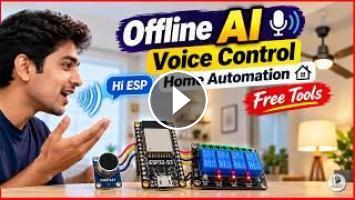
In this project, we build an Offline AI Voice Control Home Automation system using ESP32-S3, ESP-IDF and ESP-SR. The ESP32-S3 processes voice commands locally using the ESP-SR speech recognition framework, so voice control does not require a cloud service, WiFi router, or internet connection.
Enroll Altium Student Lab for FREE: https://www.altium.com/in/yt/techstudycell
Limited Time offer for students.
An INMP441 I2S microphone captures the voice, while ESP-SR handles wake-word detection and speech command recognition.
After saying "Hi ESP", you can control connected appliances such as a switch, fan, TV and lamp using simple voice commands like "Switch on", "Fan on". The ESP32-S3 also creates its own WiFi Access Point for a local web interface, allowing manual control of the relays when required.
During the ESP32S3 AI tutorial video, I covered the following topics:
00:13 Quick Demo on ESP32 AI Voice Control home automation project.
02:41 Required components for the ESP32 Home Automation project
02:56 Circuit diagram of ESP32S3 INMP441 control relays
03:37 Steps to flash the ESP32S3 for AI Voice Control relays project.
05:20 How to check the debug messages to test the ESP32 project.
06:34 How to connect with access point and configure the ESP32.
08:36 How I developed the firmware using VS Code, ESP-IDF and ESP-SR
Required Components
• ESP32-S3 N16R8 development board
• INMP441 I2S microphone
• 4-channel relay module
• 5mm LED
• 220 ohm resistor
Download the firmware for this Offline AI Voice Control Home Automation Project:
https://iotcircuithub.com/wp-content/uploads/2026/09/Code_ESP32S3_AI_Voice_Home_Automation_v1.zip
ESP32 Flash Download Tool : https://docs.espressif.com/projects/esp-test-tools/en/latest/esp32/production_stage/tools/flash_download_tool.html
Software & Tools used to prepare the firmware:
• ESP-IDF 6.1
• ESP-SR speech recognition framework
• ESP-SR MultiNet for offline speech command recognition
• Visual Studio Code with ESP-IDF extension
• Free/open-source development tools
Key Features:
• Works completely offline for voice control – no cloud AI or internet connection is required.
• No WiFi router required for voice control – the ESP32-S3 performs the speech processing locally.
• ESP32-S3 creates its own WiFi Access Point for the local web control interface.
• Offline AI speech recognition using ESP-SR.
• Wake-word detection – say "Hi ESP" to activate voice command listening.
• Local voice processing – the microphone audio is processed directly by the ESP32-S3.
• INMP441 I2S microphone provides digital audio input.
• 4-channel relay control for different appliances.
• Simple voice commands such as:
- Switch1 on
- Switch1 off
• Visual listening indication using an external LED.
• Local web control through the ESP32-S3 Access Point.
• Manual and voice control can be used together.
• No paid cloud AI service required.
• Uses ESP-IDF and ESP-SR, making the project suitable for experimenting with embedded AI and voice-controlled IoT.
How This Project Works:
• ESP32-S3 acts as the main controller.
• INMP441 captures voice through the I2S interface.
• ESP-SR AFE processes the microphone audio.
• WakeNet detects the wake word "Hi ESP".
• After "Hi ESP", the system enters voice-command listening mode and turns on the status LED.
• MultiNet recognizes predefined commands such as "Fan on" or "Lamp off" locally.
• The corresponding relay is switched ON/OFF based on the recognized command.
• The system then returns to wake-word detection mode.
• The ESP32-S3 also creates its own WiFi Access Point for the local web control interface.
• The web interface allows manual relay control without an external WiFi router.
Limitations:
• This is an offline voice-command system, not a general-purpose AI assistant.
• It recognizes only the predefined voice commands configured in ESP-SR.
• Use simple device names such as Switch, Fan etc., for better recognition.
• Voice recognition can be affected by background noise, pronunciation, microphone position, and distance.
#esp32s3 #homeautomation #iotprojects #voicecontrol
---------
Thanks For Watching...
✅ SUBSCRIBE ✅LIKE ✅SHARE ✅ COMMENTS
Find out more such projects: https://iotcircuithub.com/
Facebook: https://www.facebook.com/techstudycell/
Instagram: https://www.instagram.com/techstudycell/
Telegram: https://t.me/techstudycell/
---------
---------
WARNING:
This video is for demonstration and educational purposes only.
Each demonstration presents risks and hazards that must be fully understood before attempting.
And should be performed only by professionals
---------
Other useful IoT projects:
Latest ESP32 projects playlist:
https://www.youtube.com/playlist?list=PLlBmS9EKFydee7YsvVP_5TiPDeH38PwlK
Latest NodeMCU projects playlist:
https://www.youtube.com/playlist?list=PLlBmS9EKFydcv9ffXm72-cU9_EusicIjO
Arduino Home Automation Projects playlist:
https://youtube.com/playlist?list=PLlBmS9EKFydcxOoCht4ocLEV5zUdoCwsd
- Категория
- AI для YouTube & Shorts
Выполните вход или зарегистрируйтесь для отправки комментария.
Комментариев нет.
Следующее
Auto
-
09:36

ai voice generator free | ai voice kaise generate kare | text to speech | best ai voice generator
-
14:22
Make Unlimited Ai Images & Videos Offline - How to use Stable Diffusion Offline
-
12:26
ai voice generator free | ai voice kaise generate kare | text to speech | best ai voice generator
-
09:30
Gemini AI में FREE Motion Control कैसे करें | Unlimited Motion Control Free | Free Motion Control
-
00:34
ESP32 Home Automation Project
-
00:11
DIY home automation with ESP32 using raindrops detection and servo motor
-
06:30
Top 5 FREE AI Voice Generators Like ElevenLabs | Realistic AI Voice & Voice Cloning
-
00:16
DIY home Automation with ESP32 using Raindrops sensor
-
06:48
Ai Voice Generator Free | Best ai Voice generator | ai voice kaise generate kre in hindi &Free
-
00:30
ESP32-H2 Supermini #esp32
-
13:39

Best AI Tools For Research in 2026 (Beats ChatGPT & 0% Detection)
-
00:37
3 AI tools for programmers
-
00:55

The Best AI Tools For Content Creators
-
00:58

7 AI tools you NEED to try!
-
00:12

Best AI Tools For Hacker
-
11:15

10 Best AI Tools You MUST Try in 2025
-
00:28
The most popular AI tools right now... which one is best?
-
00:36
Best Free AI Tools for Research Papers & Essays | Write Smarter!
-
14:34

Google's NEW AI Tools Will BLOW YOUR MIND | Google I/O 2026
-
00:18
Best FREE AI Tools for Designers | Boost Your Creativity #ai #aitools #graphicdesign #designer
 Загрузка...