

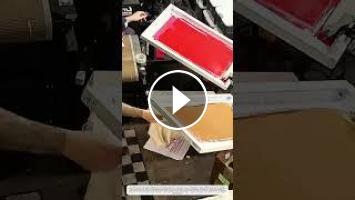
Screen printing remains one of the most widely used printing techniques because it combines precision, repeatability, and efficient production. This video presents a satisfying close-up of a manual screen-printing process where a worker carefully uses a squeegee to spread ink across a printing screen. Instead of relying entirely on automation, the operation demonstrates how skilled hand movements and consistent pressure contribute to producing clean and uniform printed results. Every pass across the screen highlights the importance of preparation, technique, and careful execution in professional printing.
The video begins with a printing screen mounted securely on a printing station. A layer of ink is visible across one side of the mesh while the screen is positioned above the material being printed. The operator grips a wide squeegee with both hands and places its edge against the ink. Applying steady pressure, the worker pulls the squeegee smoothly across the entire screen in a single controlled movement. As the squeegee advances, the ink is pushed evenly across the mesh, transferring the visible design through the open areas of the screen onto the surface beneath. After completing the stroke, the operator repositions the tool and prepares the screen for the next printing cycle. Throughout the sequence, the movements remain smooth, consistent, and deliberate, emphasizing the importance of maintaining even pressure from one edge to the other. The process illustrates how a blank surface is transformed into a printed product through accurate manual control and careful coordination.
Based strictly on the visible footage, the screen functions as the template that guides where the ink passes, while the squeegee distributes the ink evenly across the mesh using manual pressure. The operator controls the speed, angle, and consistency of each stroke. The camera does not reveal the composition of the ink, the mesh specifications, or the exact material receiving the print. Therefore, this explanation is intentionally limited to the actions visible on screen without assuming manufacturing specifications.
From a productivity standpoint, manual screen printing enables consistent reproduction of the same design while maintaining good control over print quality. Even ink distribution helps reduce inconsistencies, minimizes material waste, and supports efficient production of multiple identical prints. Consistent technique also contributes to improved visual quality and greater production reliability.
Ultimately, this video demonstrates that exceptional printing quality is created through the partnership between skilled craftsmanship and simple yet effective tools. A single controlled stroke transforms an ordinary blank surface into a professionally printed design, reminding us that precision, patience, and attention to detail remain the foundation of outstanding manufacturing.
- Категория
- AI для YouTube & Shorts
Выполните вход или зарегистрируйтесь для отправки комментария.
Комментариев нет.
Следующее
Auto
-
1:32:54

This plain little nanny, actually win two CEOs' hearts!
-
01:43
Can ChatGPT screen you for dementia?
-
15:00
ChatGPT Can Now See Everything You Do On Your Screen
-
08:17
This FREE & UNLIMITED AI Image Generator is Hiding in Plain Sight!
-
15:58
New Ultra Detailed AI 3D Model Generator is Here - Hi3D V3.0 (2048³ voxel)
-
05:52
Free Cinematic AI Ad Generator That Actually Looks Realistic | Detailed Tutorial With Prompts
-
00:25
This laptop with 100 Inch Screen...
-
00:15
Recraft AI: Turn Ideas Into Professional Designs With AI #RecraftAI #AIGraphics #aiforbusiness
-
00:27
MOES Smart 3.5-Inch Control Panel with 3 Physical Buttons | Smart Home Wall Screen
-
00:34
Top 3 free AI websites to automate your daily work in 2026. Fast-paced delivery, clear screen r...
-
13:39

Best AI Tools For Research in 2026 (Beats ChatGPT & 0% Detection)
-
00:37

3 AI tools for programmers
-
00:55

The Best AI Tools For Content Creators
-
00:58

7 AI tools you NEED to try!
-
00:12

Best AI Tools For Hacker
-
11:15

10 Best AI Tools You MUST Try in 2025
-
00:28

The most popular AI tools right now... which one is best?
-
00:36
Best Free AI Tools for Research Papers & Essays | Write Smarter!
-
14:34

Google's NEW AI Tools Will BLOW YOUR MIND | Google I/O 2026
-
00:18

Best FREE AI Tools for Designers | Boost Your Creativity #ai #aitools #graphicdesign #designer
 Загрузка...