

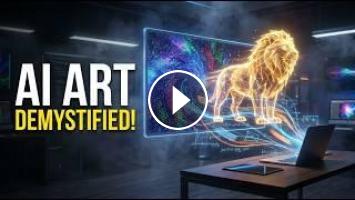
Have you ever opened an AI art tool like Midjourney, Stable Diffusion, or DALL-E, typed in a wild prompt like "a golden lion emerging from colorful dust," and watched in absolute awe as a stunning, high-fidelity masterpiece resolved on your screen in seconds? It feels like raw digital magic. But under the hood of that text box is an incredibly elegant, physics-inspired machine learning system. In this video, we pull back the curtain on "Latent Diffusion" and explain exactly how AI models sculpt beautiful artwork out of raw static—explained simply for absolute beginners!
First, we deconstruct the counterintuitive paradigm of "Diffusion." Unlike older AI models that try to guess and paint an image in a single pass, modern systems do the exact opposite: they start with a canvas of pure, random pixel noise. We'll show you how models are trained via "Forward Diffusion"—taking real photos and adding layers of static over 1,000 steps until they are unrecognizable—and how "Reverse Diffusion" teaches the neural network to predict and subtract that noise to carve out a clean image.
Next, we look at the brilliant engineering hack that made AI art accessible to everyone: "Latent Space." We explain why running 1,000 steps of math directly on a standard 512x512 image is a massive computational bottleneck, requiring industrial supercomputers. Discover how a specialized model called a Variational Autoencoder (VAE) compresses those 262,144 pixels down to a tiny 64x64 grid of mathematical variables, slashing the processing data by 48 times and letting you run these tools locally on a standard laptop!
Then, we explore the three-part engine that coordinates behind the scenes to guide the creation process. We break down the VAE's dual role as an encoder and decoder, and show you how OpenAI's CLIP model translates your written words into a mathematical "concept vector" in a shared coordinate space. Learn how the U-Net Noise Predictor uses "Cross-Attention" to match your CLIP prompt vector against the noisy canvas, recognizing and enhancing patterns that look like your request at every step.
Finally, we reveal how mathematics accelerated this entire process from minutes to milliseconds. Discover "Schedulers"—advanced mathematical algorithms like Euler and DDIM that act as high-speed navigators, calculating massive leaps through the static. See how they compressed the original 1,000-step generation loop down to just 20 to 50 highly precise steps, enabling you to generate museum-quality digital art in the blink of an eye.
If you love exploring the fascinating science and math behind the everyday technology shaping our digital future, hit that Subscribe button on Kashan Creates for more weekly tech and engineering deep dives!
=================
⏱️ TIMESTAMPS:
=================
0:00 - The Magic of AI Art
1:12 - Sculpting from Noise: The Diffusion Concept
2:20 - Training vs. Generation (Forward & Reverse Diffusion)
3:40 - The Pixel Bottleneck: Why Direct Diffusion Fails
4:55 - Latent Space & the 48x VAE Compression Hack
6:15 - The CLIP Text Encoder: Translating Words to Coordinates
7:35 - Inside the U-Net: The 'U-Shaped' Noise Sculptor
9:10 - Cross-Attention: Looking Through the Static
10:20 - Schedulers: Cutting 1,000 Steps Down to 20
11:45 - Outro & Wrap Up
- Категория
- AI Картинки
Выполните вход или зарегистрируйтесь для отправки комментария.
Комментариев нет.
Следующее
Auto
-
00:11

Ideogram AI: Create Stunning AI Images & Text in Seconds
-
01:11
Create Viral 4K Ai Art Reels | How To Make Peaceful Ai Art Reels | Ai Art Reels Video Kaise Banaye
-
04:48
Best FREE AI Image Generators in 2026 Create Amazing Images in Seconds!
-
00:56
Unlock AI Art Generators: Create Stunning Digital Art for Free!
-
08:06
FREE AI Art Generator with NO Limits | GenTube Tutorial (Create Stunning AI Images in Seconds)
-
08:25
AI Digital Art Generator – Create Stunning Artwork in Seconds with AI
-
00:50
Top 5 Best AI Image Generators of 2026 | Create Amazing AI Art in Seconds!#AITools #AIImages
-
04:20
ai art magic photo generator app | ai art generator app kaise use kare | ai art magic photo app
-
01:37
Top 5 FREE AI Image Generators 2026| Create Stunning AI Images in Seconds | Best AI Image Generators
-
00:27
Free AI Image Generator – Create Unlimited Images in Seconds!
-
13:39

Best AI Tools For Research in 2026 (Beats ChatGPT & 0% Detection)
-
00:37
3 AI tools for programmers
-
00:55
The Best AI Tools For Content Creators
-
00:58

7 AI tools you NEED to try!
-
00:12

Best AI Tools For Hacker
-
11:15
10 Best AI Tools You MUST Try in 2025
-
00:28
The most popular AI tools right now... which one is best?
-
00:36
Best Free AI Tools for Research Papers & Essays | Write Smarter!
-
14:34
Google's NEW AI Tools Will BLOW YOUR MIND | Google I/O 2026
-
00:18
Best FREE AI Tools for Designers | Boost Your Creativity #ai #aitools #graphicdesign #designer
 Загрузка...