

What actually powers generative AI models like image generators, video models, audio synthesis systems, and large-scale creative AI?
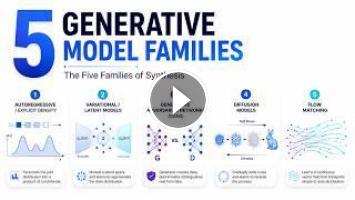
In this video, we break down Generative Architecture: The Five Families of Synthesis — a practical taxonomy for understanding how modern generative models create realistic content from complex data distributions.
You will learn how different model families approach generation, including explicit density models, implicit density models, GANs, diffusion models, and flow matching architectures. We also explain why diffusion and flow matching have become dominant in high-resolution image and video synthesis, and how each architecture makes trade-offs between likelihood estimation, sampling speed, quality, stability, and compute cost.
This is a foundational topic for anyone learning AI Engineering, Generative AI, Machine Learning, Computer Vision, LLM systems, or AI research paper reading.
What You’ll Learn
↳ What generative models are really trying to learn
↳ The five major families of generative architectures
↳ Why GANs became famous for sharp visual synthesis
↳ Why diffusion models dominate modern image and video generation
↳ How flow matching improves generation efficiency and stability
↳ How to evaluate new generative AI research papers
↳ How to choose the right architecture for real-world AI systems
By the end, you will understand the architecture behind modern generative AI — not just the hype.
#GenerativeAI #AIEngineering #MachineLearning #DiffusionModels #FlowMatching #GANs #DeepLearning #ArtificialIntelligence #ComputerVision #AIResearch
- Категория
- AI Картинки
Выполните вход или зарегистрируйтесь для отправки комментария.
Комментариев нет.
Следующее
Auto
-
06:22

Top 10 Generative AI Tools You Should Know in 2026 | Top 10 Generative AI Tools
-
30:01
Flow Matching & Rectified Flows: The Recipe Behind Modern AI Image and Video Models
-
07:32
How Modern Generative Algorithms (VAEs, GANs, Diffusion Models, Autoregressive Models) Actually Work
-
08:50
Diffusion Models Explained | Stable Diffusion, U-Net, Transformers & Generative AI
-
22:34:47
Generative AI Full Course 2026 | Generative AI Tutorial For Beginners | Gen AI Course | Simplilearn
-
03:48
Best Websites to Download Free Revit Families in 2026 | Top Revit Family Libraries
-
07:48
Understanding Generative AI Models Types and Architectures
-
07:39
Flow Matching Explained: The Fast Generative AI Behind Flux and Stable Diffusion 3
-
01:25
How Stable Diffusion Works: The Basic Intuition Behind Generative AI
-
2 Robot Có Thể Thay Thế Toàn Bộ Nhân Viên Giữ Xe?
-
13:39

Best AI Tools For Research in 2026 (Beats ChatGPT & 0% Detection)
-
00:37

3 AI tools for programmers
-
00:55

The Best AI Tools For Content Creators
-
00:58

7 AI tools you NEED to try!
-
00:12

Best AI Tools For Hacker
-
11:15

10 Best AI Tools You MUST Try in 2025
-
00:28

The most popular AI tools right now... which one is best?
-
00:36
Best Free AI Tools for Research Papers & Essays | Write Smarter!
-
14:34

Google's NEW AI Tools Will BLOW YOUR MIND | Google I/O 2026
-
00:18

Best FREE AI Tools for Designers | Boost Your Creativity #ai #aitools #graphicdesign #designer
 Загрузка...