

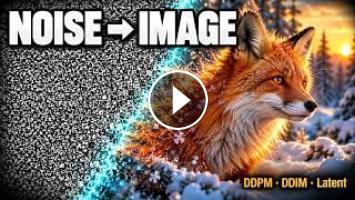
Standard text-to-image diffusion sampling, as in Stable Diffusion v1, DALL·E 2 and Imagen, starts from random noise. Image editing can start from a noised input image, and the original DALL·E was autoregressive. In this video we build diffusion models from the ground up and see exactly how a neural network learns to turn noise into images.
We start with the forward process, which slowly destroys an image with Gaussian noise and can jump to any noise level in a single step. Then we reverse the arrow: a time-aware U-Net learns to undo the noise, one small Gaussian step at a time. You will see why the DDPM paper's key trick, predicting the noise instead of the image, reduces training to a simple mean squared error.
Next, a second lens: score matching. We connect noise prediction to the gradient of log-probability, from Hyvärinen's score matching and Vincent's denoising score matching to Langevin dynamics, noise-conditional score networks and the SDE framework.
Then DDPM vs. DDIM: how the same trained network can use far fewer steps with a deterministic sampler. The DDIM paper reported 10-50× wall-clock speedups in its experiments, with a quality, speed trade-off, and demonstrated interpolation and approximate inversion. Finally, latent diffusion, the architecture behind Stable Diffusion v1: an autoencoder represents 512×512×3 images as 64×64×4 latents, 48× fewer tensor values, diffusion runs in latent space, cross-attention connects text, and classifier-free guidance makes the model follow your prompt.
All formulas are shown on screen, with the idea behind each one explained in plain language.
- Категория
- AI Картинки
Выполните вход или зарегистрируйтесь для отправки комментария.
Комментариев нет.
Следующее
Auto
-
01:36

Stable Diffusion: From Noise to Images
-
05:06
How AI Creates Images From Noise (Diffusion Models Explained)
-
09:11
Diffusion Models Explained: Build DDPM from Scratch
-
2:26:40
Your Comment Becomes the Video: YouTube Plays Diffusion
-
07:20
How AI Turns Noise Into Images — Diffusion Models Explained
-
00:48
How Diffusion Models Make Images from Noise: Stable Diffusion Explained #Shorts
-
00:23
Inside Stable Diffusion: How Noise Becomes Your Photo in 0.04 Seconds
-
20:59
Diffusion Models Explained — DDPM, Stable Diffusion & How AI Art Works (Deep Learning EP43)
-
08:26
ControlNet, LoRA & IP-Adapters Explained: How AI Image Generation Becomes Controllable
-
04:11
Diffusion Models Explained: DDPM, DDIM, Latent Diffusion and Stable Diffusion
-
13:39

Best AI Tools For Research in 2026 (Beats ChatGPT & 0% Detection)
-
00:37
3 AI tools for programmers
-
00:55

The Best AI Tools For Content Creators
-
00:58

7 AI tools you NEED to try!
-
00:12

Best AI Tools For Hacker
-
11:15

10 Best AI Tools You MUST Try in 2025
-
00:28

The most popular AI tools right now... which one is best?
-
00:36
Best Free AI Tools for Research Papers & Essays | Write Smarter!
-
14:34

Google's NEW AI Tools Will BLOW YOUR MIND | Google I/O 2026
-
00:18

Best FREE AI Tools for Designers | Boost Your Creativity #ai #aitools #graphicdesign #designer
 Загрузка...