

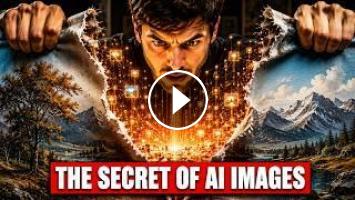
What actually happens when you type a prompt into an AI image generator? It is not magic, and it is definitely not just copy-pasting images from a database.
Discover the mind-bending science and physics behind how artificial intelligence turns pure random TV static into photorealistic masterpieces.
In this video, we go behind the scenes of the world's most powerful artificial intelligence models like Midjourney, DALL-E 3, and Stable Diffusion to explain exactly how generative AI works. We break down complex computer science and machine learning concepts—like diffusion models, latent space, and the CLIP text encoder—into easy-to-understand visual metaphors.
Whether you are curious about how text-to-image generation actually sculpts pixels from random noise, or you want to know how advanced AI video generators like OpenAI's Sora 2 and Google's Veo 3.1 maintain perfect physics and lighting over time, this deep dive reveals the hidden anatomy of a prompt. We also explore the ethical controversies, current limitations like AI struggling to generate hands and text, and what the future of generative AI holds.
In this video, we cover:
1. The hidden map of AI: Understanding Latent Space, neural networks, and data compression
2. How Diffusion Models use the physics of reversing time to create art from static.
3. The anatomy of a prompt: Translating human language into images using the CLIP model.
4. The massive leap from AI images to Generative AI Video using Spacetime Patches and Diffusion Transformers.
5. The perceptual science behind why AI-generated deepfakes look so hyper-realistic.
6. The truth about AI copyright, training data, and the limitations of machine learning.
If you found this breakdown of artificial intelligence helpful, be sure to hit that subscribe button for more deep dives into the fast-paced world of technology and machine learning! Drop a comment below: what is the absolute craziest thing you would generate if you had access to the most powerful AI model in the world?
- Категория
- AI Картинки
Выполните вход или зарегистрируйтесь для отправки комментария.
Комментариев нет.
Следующее
Auto
-
04:07

Best AI Image Generator in 2026: Every Major Model Compared (Nano Banana, GPT Image 2 & More)
-
14:05
Seedream 5.0 Pro vs GPT Image 2 vs Nano Banana 2 - The BEST AI Image Generator?
-
19:37
Nano Banana 2.1 vs GPT Image 2.5 vs Seedream 5.0 - Which AI Image Generator Wins?
-
02:51
GPT image 2.5 vs Seedream5.0 Pro vs Google nano banana 2- Who's The BEST AI Image Generator of 2026?
-
00:47
JST Automation Team Building | A Day Behind the Scenes of Our Manufacturing Team
-
18:21
Flux 2 Pro vs Nano Banana Pro - Which is the Best AI Image Generator
-
2 Robot Có Thể Thay Thế Toàn Bộ Nhân Viên Giữ Xe?
-
01:09
How AI Agents Work Behind the Scenes | The Technology Powering AI Agents | #Shorts | #Simplilearn
-
Dubai: Behind the Scenes of AI and YouTube Automation
-
00:17
Behind the scenes | viral edits in capcut
-
13:39

Best AI Tools For Research in 2026 (Beats ChatGPT & 0% Detection)
-
00:37
3 AI tools for programmers
-
00:55

The Best AI Tools For Content Creators
-
00:58

7 AI tools you NEED to try!
-
00:12

Best AI Tools For Hacker
-
11:15
10 Best AI Tools You MUST Try in 2025
-
00:28
The most popular AI tools right now... which one is best?
-
00:36
Best Free AI Tools for Research Papers & Essays | Write Smarter!
-
14:34
Google's NEW AI Tools Will BLOW YOUR MIND | Google I/O 2026
-
00:18
Best FREE AI Tools for Designers | Boost Your Creativity #ai #aitools #graphicdesign #designer
 Загрузка...